
Difference Between SEO and GEO: What Businesses Need to Know
The way people search for information online is changing quickly. For years, businesses focused mainly on Search Engine Optimization (SEO) to improve their visibility on Google and other search engines. The goal was to rank higher, attract more visitors, and generate leads through organic search.
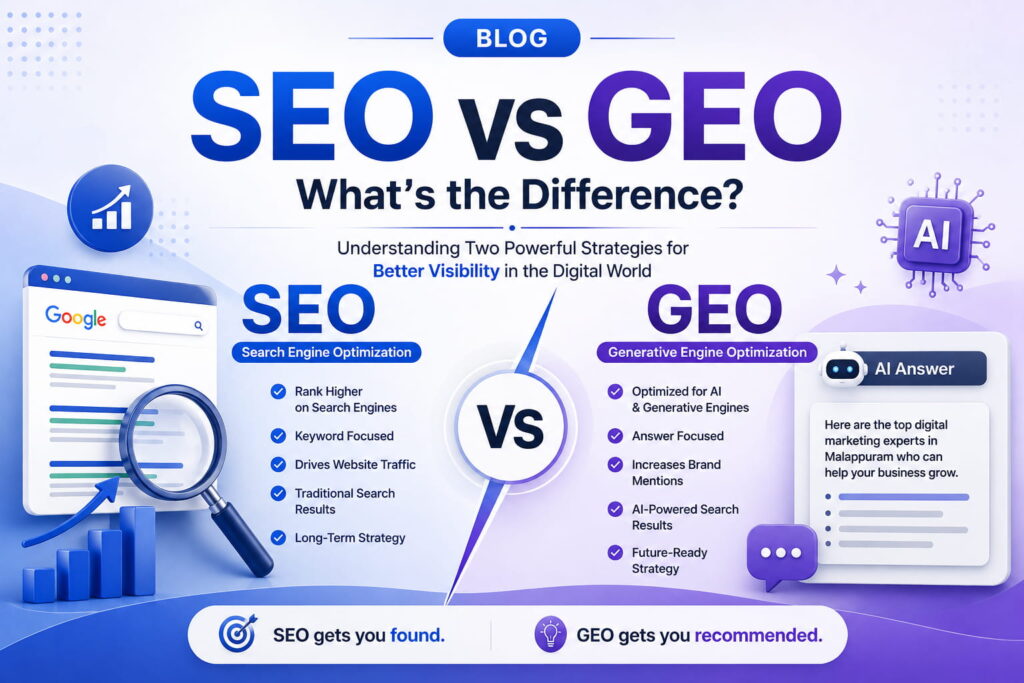
But now, people are increasingly using AI tools such as ChatGPT, Google AI Overviews, Microsoft Copilot, and other generative search platforms to find information. Instead of searching for a few keywords and visiting several websites, users can ask complete questions and receive detailed answers within seconds.
This change has created a new area of digital marketing called Generative Engine Optimization (GEO).
SEO and GEO have similar goals—improving online visibility—but they work in different ways. Understanding the difference between them can help businesses prepare for the future of search.
What is SEO?
Search Engine Optimization (SEO) is the process of improving a website so that it can rank higher in traditional search engine results.
For example, imagine someone searches for “Digital Marketing Expert in Malappuram.” Google looks at different websites and considers factors such as relevance, content quality, website experience, authority, and backlinks before deciding which pages should appear in the search results.
A strong SEO strategy usually includes:
- Keyword research
- On-page SEO
- Technical SEO
- Content creation
- Link building
- Local SEO
- Website speed optimization
- Mobile optimization
The main purpose of SEO is to help your website appear in search results and encourage users to click on your website.
In simple terms, SEO helps people find your website through search engines.
What is GEO?
Generative Engine Optimization (GEO) is the process of creating and optimizing content so that AI-powered search engines and generative AI platforms can understand, reference, and potentially include your brand or content in their answers.
Instead of simply trying to rank at the top of a list of search results, GEO focuses on increasing the chances that your business will be mentioned or represented in an AI-generated response.
For example, a user might ask an AI platform:
“Who are the best digital marketing experts in Malappuram?”
Instead of showing a traditional list of blue links, the AI may generate a response based on information it has found and understood from different sources.
This means businesses now need to think beyond traditional rankings and consider how their content can become useful and trustworthy information for AI systems.
SEO vs GEO: What’s the Main Difference?
The biggest difference between SEO and GEO is where and how your content appears.
SEO focuses mainly on traditional search engines and improving rankings in search results.
GEO focuses on generative AI and increasing the likelihood that your content, brand, products, or expertise will be represented in AI-generated answers.
For example:
SEO:
A user searches for “SEO services in Malappuram” and finds your website on Google’s search results.
GEO:
A user asks an AI search tool, “What are some good SEO services in Malappuram?” The AI may mention your business as part of its response if your online presence provides relevant and trustworthy information.
So, you can think of it this way:
SEO = Getting found in search results.
GEO = Getting recognized and represented in AI-generated answers.
Why is SEO Still Important?
The rise of AI doesn’t mean SEO is becoming useless. In fact, SEO is still an important part of digital marketing.
People continue to use search engines to research businesses, compare products, read reviews, find services, and make purchasing decisions.
Good SEO can help a business:
- Increase organic website traffic
- Improve search visibility
- Generate leads
- Build brand awareness
- Establish online authority
- Attract potential customers
SEO also provides a strong foundation for GEO because well-structured, useful, authoritative content is valuable to both traditional search engines and AI systems.
Why is GEO Becoming Important?
Generative AI is changing the way people discover information.
Instead of searching several websites individually, users can now ask AI tools detailed questions and receive summarized answers.
This creates a new opportunity for businesses. If your brand is consistently mentioned, referenced, or represented in relevant AI-generated answers, it can increase your visibility and brand awareness.
GEO encourages businesses to focus on things such as:
- Providing accurate information
- Demonstrating expertise
- Creating useful and original content
- Answering specific questions
- Building brand authority
- Maintaining a strong online presence
- Getting mentioned by reliable third-party sources
The goal is not simply to create content for search engines. It’s about becoming a reliable source of information that AI systems can understand and use.
How SEO and GEO Work Together
SEO and GEO should not be treated as two completely separate strategies.
A business can use SEO to build a strong website and online presence while using GEO principles to make its content easier for AI systems to understand.
For example, creating a detailed service page can help your website rank for relevant Google searches. If that page clearly explains your services, expertise, location, and customer benefits, the information may also be useful for AI-powered search systems.
Some practices that can support both SEO and GEO include:
- Creating helpful, original content
- Answering real customer questions
- Using clear headings and structured content
- Demonstrating expertise and experience
- Keeping business information accurate
- Building quality backlinks and brand mentions
- Optimizing pages for user intent
- Maintaining an active and trustworthy online presence
SEO or GEO: Which One Should You Focus On?
You don’t necessarily have to choose between SEO and GEO.
For most businesses, the better approach is to combine both.
SEO helps you build visibility across traditional search engines, while GEO helps you prepare for the growing influence of generative AI search.
Think of SEO as building a strong foundation for your online presence. GEO builds on that foundation by making your brand and content more understandable and useful within AI-driven search experiences.
Final Thoughts
SEO and GEO represent two important parts of the changing search landscape.
SEO focuses on helping websites rank and attract visitors from traditional search engines. GEO focuses on improving a brand’s visibility and representation within AI-generated answers.
As search continues to evolve, businesses should not focus only on ranking for keywords. They should also focus on creating content that is genuinely useful, accurate, trustworthy, and easy to understand.
The future of digital marketing isn’t necessarily about SEO vs GEO. It’s about using SEO and GEO together to make your business visible wherever your customers are searching—whether they’re clicking Google results or asking an AI for an answer.